Stablecoin API
USDC and USDT routes with exact token identity, network selection, confirmation, treasury, refunds, and reconciliation.
Stablecoin guide →Design payment intents, route cards and bank transfers, accept stablecoins and crypto invoices, manage regional payout paths, and reconcile every movement to an auditable ledger.
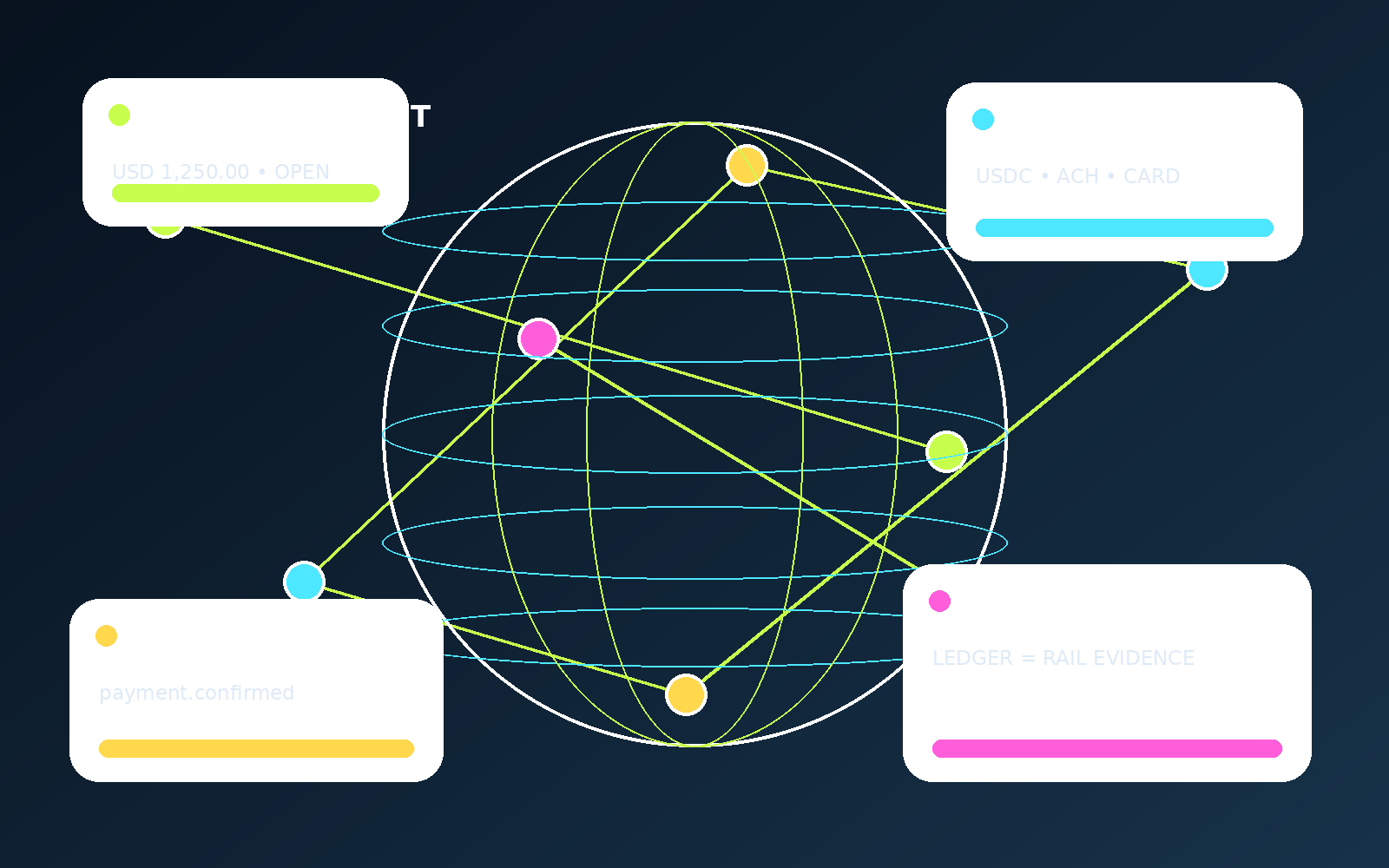
The customer sees one order. Your platform still has to preserve the native facts of every rail: authorization, confirmation, settlement, return, dispute, refund, conversion, and payout.
USDC and USDT routes with exact token identity, network selection, confirmation, treasury, refunds, and reconciliation.
Stablecoin guide →Rules-aware API design for bank files, credits, debits, schedules, returns, account changes, and trace-level matching.
Banking guide →Bitcoin, Ethereum, Solana, stablecoin, and World Chain payment attempts under one commercial invoice.
Invoice guide →Corridor-first planning for Asia, Africa, GCC and MENA markets, South America, FX, local methods, and beneficiary payout.
Regional guide →A production payment platform separates the commercial order from rail observations, policy decisions, ledger postings, and outbound communication.
Merchant, amount, currency, accepted routes, expiration, and fulfillment state.
Eligibility, customer choice, risk, network capability, FX, and settlement terms.
Card authorization, ACH submission, wallet instruction, or onchain evidence.
Balanced entries matched to processors, banks, custodians, and chain records.
A canonical payment object can make merchant integration predictable. Capabilities and sub-states keep the underlying rail honest.
{
  "id": "pay_01J...",
  "amount": { "value": "1250.00", "currency": "USD" },
  "route": {
    "family": "stablecoin",
    "asset": "USDC",
    "network": "selected-at-runtime"
  },
  "commercial_state": "awaiting_payment",
  "rail_state": "instruction_created",
  "risk_state": "allowed",
  "ledger_state": "not_posted",
  "expires_at": "2026-10-21T23:00:00Z"
}Every article uses an original featured image, a distinct topic, internal implementation links, and one carefully selected primary-source editorial reference.

A practical architecture for payment intents, chain abstraction, confirmations, webhooks, compliance controls, and reconciliation across stablecoin rails.
Read guide →
A practical design for ACH credits and debits, direct deposit, authorization evidence, return handling, idempotency, and bank-grade reconciliation.
Read guide →
A corridor-first framework for payment methods, FX, settlement, data, compliance, and operations across diverse regional markets.
Read guide →Payment architecture is easier to reason about when the commercial promise, financial-service provider, rail behavior, and educational source are not mixed together.
No. WorldPayAPI.com is an independent educational publication. It does not open accounts, issue API keys, hold funds, provide custody, or process payments.
No. WorldPayAPI.com is not affiliated with Worldpay, Inc., FIS, Global Payments, or any similarly named provider. Product names and trademarks belong to their respective owners.
It is a useful generic description for an orchestration layer that connects commercial payment intents to card, bank, wallet, stablecoin, and payout rails while preserving rail-specific evidence and controls.
A canonical payment model can support those routes, but each adapter needs its own state machine, confirmation or settlement policy, data requirements, reconciliation evidence, and exception handling.
A transfer may be observed quickly, but availability depends on network confirmation, provider status, compliance policy, custody operations, and any conversion or bank payout needed by the merchant.
Start with one customer type, one corridor, one rail, a double-entry ledger, explicit payment states, idempotent APIs, support tooling, and reconciliation. Add routes only after the first can be operated and closed financially.
Use the developer blueprint to define payment states, idempotency, webhooks, ledger events, exception queues, and production tests.